Two Worlds, One Beat: How Young South Asian-American Artists Are Scoring Their Own Story
There's a particular kind of silence that happens when you're at a family gathering and a classic Hindi film song comes on. Your parents close their eyes. Your aunties start swaying. And you — born in New Jersey or Houston or Fremont — feel something you can't quite name. Familiarity without full fluency. Emotion without complete context.
For a growing number of young South Asian-American artists, that feeling isn't a gap to be filled. It's the whole point.
The Sound of In-Between
Call it the diaspora frequency. It's the musical space where a Carnatic melody drifts over an 808 kick drum, where Punjabi folk vocals show up inside a bedroom pop track, where a Tamil phrase lands in the middle of an R&B verse and somehow makes total sense. This isn't fusion for fusion's sake. It's something more personal — a creative act of self-definition from artists who grew up code-switching and are now doing the same thing with sound.
Artists like Priya Ragu, the Swiss-Tamil singer who's been making serious waves in the US, or Chicago-based producer Arjun Iyer, who layers sitar samples into lo-fi hip-hop beats, aren't trying to bridge two cultures so much as they're living inside the overlap. Their music doesn't ask you to pick a side. It assumes you already know what it feels like to exist in both.
"I grew up listening to my dad's AR Rahman records and then coming to school and everyone was talking about Kanye," says one LA-based producer who asked to go by his producer name, Kavi. "At some point I stopped treating those as separate things. They were both just in my head, and they started talking to each other."
Not Your Parents' Bollywood, Not Exactly American Either
What makes this moment distinct is what it's pushing back against — from both directions.
On one side, there's the pressure to represent a certain kind of South Asian authenticity. The expectation that desi music means classical training, film soundtracks, or bhangra at the right moments. On the other, there's the gravitational pull of American mainstream pop, which has historically asked artists of color to sand down the edges that make them specific.
This generation isn't interested in either compromise.
Take the growing scene of South Asian-American artists on SoundCloud and Bandcamp who are building audiences without any major label infrastructure. They're releasing tracks that sample old Bollywood film reels alongside trap hi-hats, writing lyrics that slip between English and Urdu mid-sentence, producing ambient records that feel like a meditation on the experience of driving through an American suburb while your mom calls from the other side of the world.
Listeners are finding them — and recognizing themselves immediately.
"The first time I heard a song that felt like it was actually for me, not for my parents and not for my white friends, I cried a little," admits Meera, a 24-year-old listener from the Bay Area. "It wasn't trying to explain anything to anyone. It just existed."
The Production Side of Identity
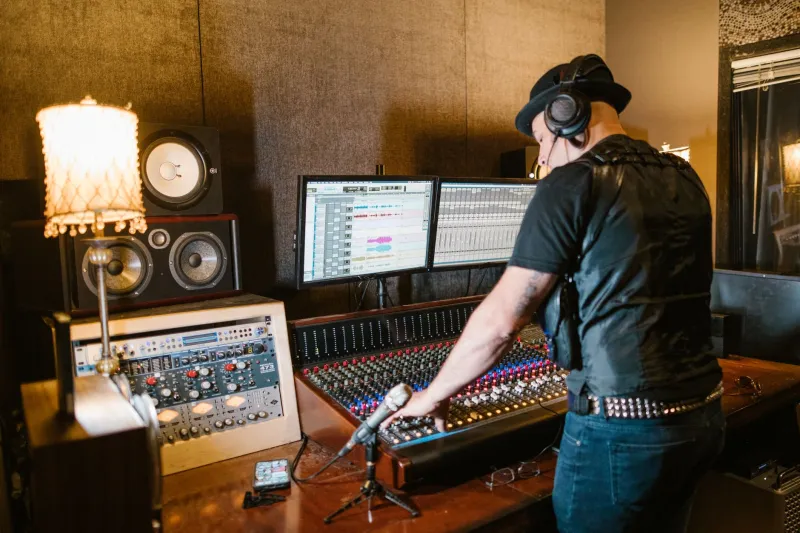
Behind the scenes, South Asian-American producers are quietly shaping the sonic landscape in ways that don't always get credited. Beatmakers who grew up on both Timbaland and Tabla are bringing rhythmic sensibilities to sessions that other producers simply don't have in their vocabulary. Polyrhythms that feel fresh to Western ears are second nature to someone who grew up hearing them at temple.
This cross-pollination is starting to surface in mainstream spaces too. You can hear it in the production choices of certain pop and R&B tracks that have that slightly unexpected rhythmic texture — the kind that makes you tilt your head and think what is that? before it locks into your body and you just move.
The influence is there. The credit is catching up slowly.
Streaming Platforms Are Finally Paying Attention
Spotify and Apple Music have started building out playlists specifically designed to capture this hybrid space — "South Asian Vibes" and "Desi Fusion" playlists that, while imperfect in their curation, signal that the platforms see an audience worth serving. It's a start, even if the algorithmic understanding of what this music actually is still has some catching up to do.
More meaningfully, independent artists in this space are finding each other. Collectives are forming in cities with large South Asian diaspora populations — New York, Chicago, LA, Houston, Atlanta. They're sharing shows, production credits, and a sense of collective purpose that feels less like a niche and more like the beginning of a movement.
The Realest Thing in the Room
What's striking, if you spend any time in this world, is how unself-conscious it's becoming. Earlier generations of South Asian-American artists often felt the need to explain themselves — to contextualize the cultural references, to make the fusion legible to a mainstream audience that might not get it.
This generation doesn't feel that obligation. The music is made for people who already understand the reference, and if you don't, you're welcome to catch up.
That confidence is new. And it sounds, honestly, like the most exciting thing happening in American independent music right now — not because it's exotic or different, but because it's specific in a way that great art always is. It's the sound of people refusing to simplify themselves, and making something genuinely beautiful out of the complexity.
That's not an identity crisis. That's an identity fully arrived.