Dressed to Tell: How South Asian Fashion Became the Most Powerful Character in the Room
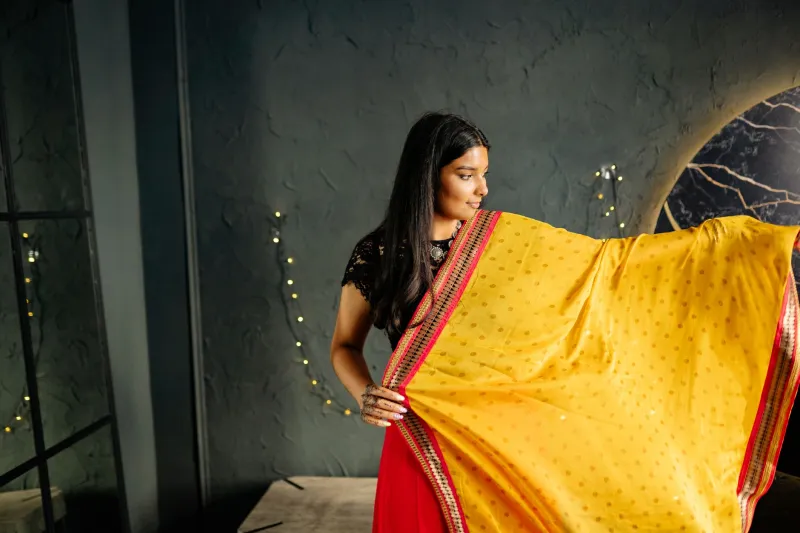
There's a scene early in Ms. Marvel where Kamala Khan's mother pulls out a dupatta — a long, sheer scarf — and drapes it over her daughter's shoulders. It's a small moment. Maybe thirty seconds. But it carries the weight of generational transmission, cultural identity, and a mother-daughter relationship that no amount of dialogue could have communicated as cleanly. The fabric does the talking.
That's not an accident. It's a choice. And it's exactly the kind of choice that South Asian costume designers, stylists, and directors have been fighting to make for years.
From Background Detail to Narrative Engine
For a long time, South Asian clothing in Western film and television existed as visual shorthand. The sari meant "she is Indian." The sherwani meant "this is a wedding." The bindi meant "this character is from somewhere else." Functional, reductive, and almost entirely decorative.
What's happening now is something fundamentally different. Designers working on prestige productions — both in Hollywood and in the increasingly globally-distributed South Asian content ecosystem — are using clothing as character development. What someone wears, how they wear it, whether they resist it or embrace it: these choices are being written into the narrative architecture of films and shows in ways that treat desi fashion with the same dramatic seriousness as any other storytelling device.
"Clothing is always biography," says Ananya Krishnan, a Los Angeles-based costume designer who has worked on several independent productions featuring South Asian leads. "When I'm dressing a character who is second-generation, I'm asking: does she still have her grandmother's salwar kameez in her closet? Does she wear it? Has she altered it? That tells you everything about who she is."
The Textiles Are the Story
Part of what makes South Asian fashion so rich as a narrative tool is the sheer specificity of the materials involved. Banarasi silk from Varanasi. Kanjivaram from Tamil Nadu. Block-printed cottons from Rajasthan. Each textile carries its own history, its own regional identity, its own class and caste associations. When a filmmaker makes a deliberate choice about which fabric a character wears, they're drawing on centuries of cultural coding.
American audiences are increasingly literate in this, particularly younger South Asian viewers who grew up watching their parents navigate these choices at weddings, religious ceremonies, and family gatherings. Seeing that knowledge reflected back from the screen — accurately, specifically, without being flattened into generic "Indian" aesthetics — lands differently. It feels like being seen.
Recent productions have started to get this right in interesting ways. The Rings of Power brought in consultants for its fictional world-building; prestige dramas with South Asian storylines are doing the same with cultural authenticity. The difference shows.
Silhouettes as Character Arc
Beyond individual garments, some of the most interesting work happening right now involves using changes in clothing silhouette to chart a character's internal journey.
A character who begins a story in Western clothing and gradually incorporates traditional South Asian elements — or vice versa — is telling you something about assimilation, reclamation, or identity negotiation without a single line of expository dialogue. It's visual storytelling at its most efficient.
Designer Preethi Nair, who has worked on both studio and streaming productions, describes the process as "building a wardrobe that argues." "I want the clothes to be in conversation with each other throughout the film," she explains. "If a character is in conflict, her wardrobe should be in conflict. If she's found peace with who she is, there should be an integration — maybe a kurta with jeans, worn with confidence rather than apology."
The Mainstream Moment
What's shifted recently is where this work is showing up. It's no longer confined to indie films or festival darlings. Major streaming platforms — Netflix, Amazon, Hulu — are producing and acquiring South Asian content at a pace that would have seemed implausible five years ago. And as budgets grow, so does the space for costume departments to do work that's genuinely ambitious.
Heeramandi, Sanjay Leela Bhansali's Netflix series, is perhaps the most maximalist example of what's possible when South Asian fashion is treated as a central creative priority. The production's costuming isn't just gorgeous — it's doing historical and emotional work, situating characters within specific traditions of courtly culture and using clothing to signal power, vulnerability, and desire.
American audiences discovering this content are responding to it. Social media is full of viewers breaking down specific outfits, identifying fabrics, tracing design lineages. The fashion is being engaged with as art, not just as backdrop.
The Designers Making It Happen
Behind the camera, there's a generation of South Asian costume designers who have spent careers building the expertise to do this work authentically — and who are finally getting the commissions to do it at scale.
Many of them describe a dual fluency that's essential to the job: deep knowledge of South Asian textile traditions and artisan communities on one hand, and a sophisticated understanding of Western film grammar and narrative convention on the other. The ability to move between those two worlds — to know when a specific embroidery style will read correctly to a South Asian audience while also being visually compelling to someone who has no cultural context for it — is a skill set that takes years to develop.
It's also a skill set that's increasingly in demand.
What Comes Next
The trajectory here feels clear. As South Asian stories move further into the mainstream of American entertainment, the visual language that tells those stories will move with them. Designers who have been working in relative obscurity are becoming names. Textiles that were specialty knowledge are becoming recognizable to general audiences.
And somewhere in that shift, something important is happening: South Asian fashion is being understood, finally, as what it has always been. Not decoration. Not signifier. Not exotic detail.
Character.